
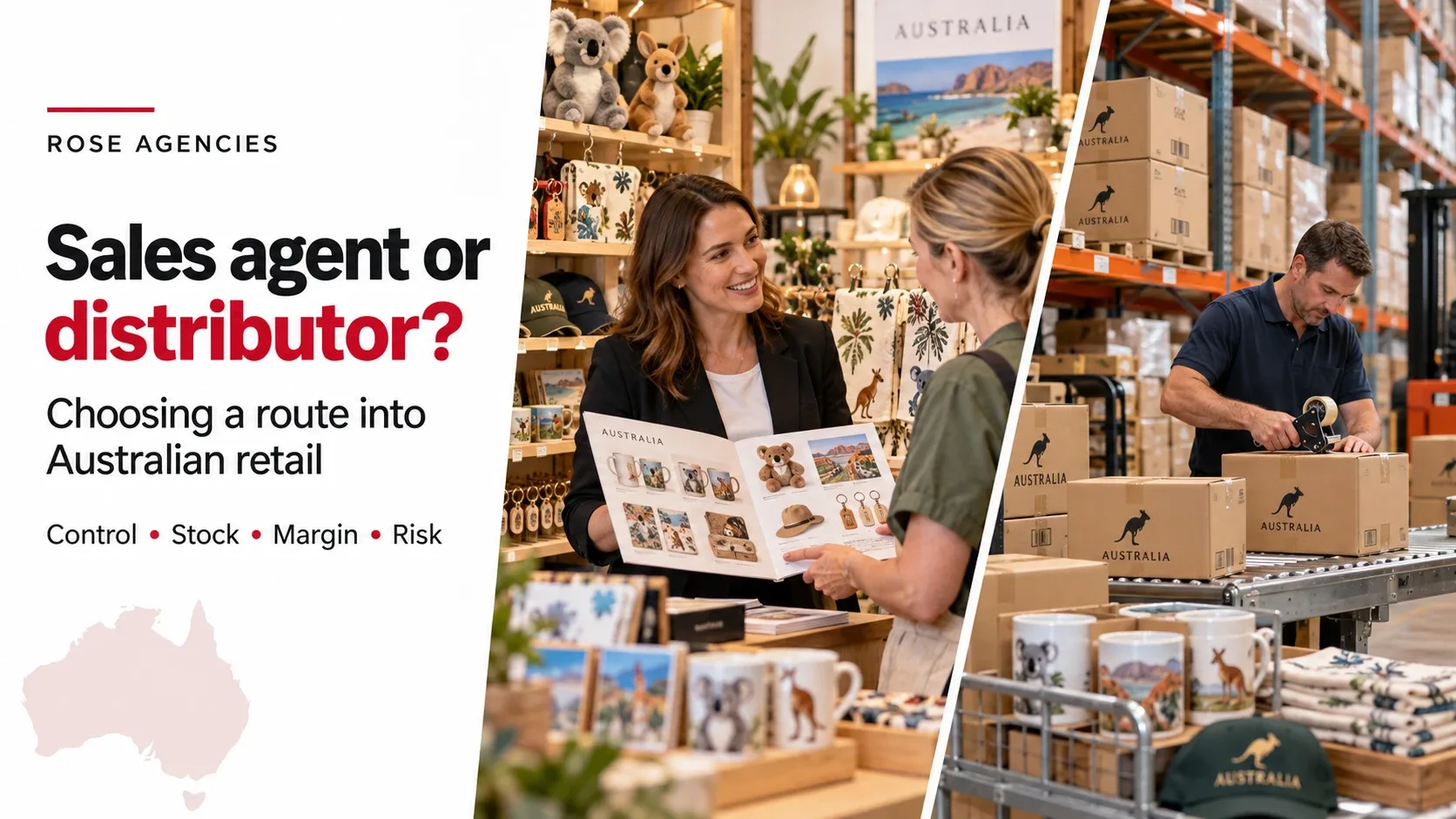
If you make or import a product and want it in Australian shops, sooner or later you’ll face a choice: do you find a sales agent, or do you sign with a distributor?
They can look similar from the outside. Both get your product in front of retailers. But they work in quite different ways, and the difference affects your margins, your stock, your cash flow and how much say you have over your own brand. Here’s the general picture, and then where I fit.
What a sales agent does
A sales agent represents your brand to retailers. The agent calls on stores, shows the range, takes orders and passes them back to you. In most cases the agent doesn’t buy or hold your stock. You keep ownership of the product until it’s sold to the retailer.
Because of that, the agent is usually paid a commission on the orders they bring in, rather than buying at one price and selling at another. The exact arrangement varies from brand to brand.
What you typically keep as the brand:
- Your stock, warehousing and dispatch, or whoever you use to handle them
- Invoicing and payment from retailers
- Your wholesale pricing and how your range is presented
- The direct relationship with each store, with the agent in the middle making it happen
What a distributor does
A distributor usually buys your stock outright, holds it in their own warehouse, and resells it to retailers at their own price. They make their money on the margin between what they pay you and what they charge the stores.
That changes the deal in a few ways:
- You get paid by one customer, the distributor, instead of hundreds of small ones.
- The distributor takes on the stock risk, the warehousing and often the credit risk with retailers.
- In return, they take a margin, and you usually hand over a lot of control over pricing, presentation and which stores you’re in.
- Distribution agreements are often exclusive for a territory or a category, so it pays to read them carefully.
Neither model is better in every case. It depends on your product and your business.
Questions that help you decide
A few honest questions usually point you the right way.
- Can you hold stock in Australia and ship orders yourself? If you can, or you have a warehouse partner who can, an agent is a natural fit. If you can’t, a distributor solves that problem for you.
- How much margin do you need to keep? A distributor needs room in your pricing to make their margin. An agent’s commission is usually a smaller slice, but you carry more of the work.
- How much control do you want? If your pricing, presentation and brand story matter a great deal to you, an agent keeps those decisions with you.
- How quickly do you need to reach stores? A distributor with an existing customer base can move a lot of stock fast. An agent who already calls on the right stores can also open doors quickly, without you giving up ownership.
- Are you ready for lots of small accounts? With an agent, you deal with every retailer’s orders, invoices and payments. Some brands love that direct contact. Others would rather have one customer.
Where I fit
I’m a sales agent. Rose Agencies holds no stock. I represent brands to retailers across all of Australia, and in most cases I work on commission, on a non-exclusive basis. Exact arrangements depend on the brand and the buyer, and who invoices, delivers and handles returns depends on how each brand runs its business.
Right now I represent Local Bloke, Kato Designs, Sundowner Souvenirs and Souvenirs Australia, and in the past I’ve represented Mad in Oz, Possi Group, Rigon Headwear and W.A. Jacobs Hatmaker.
I’ve also seen the other side. I joined my family’s Rose Stereograph business full-time in 1979, and over the years I worked as a sales rep, a photographer, a general manager and a company director of a business that chose, produced and sold its own ranges. So I understand what a brand has to manage behind the scenes, not just what happens in the shop. You can read my story and more about what an Australian sales rep does.
Today I supply 227 stockists across 132 towns and suburbs, from pharmacies and newsagencies to visitor centres and surf shops. You can see them all on the stockist map.
If you make or import a product
If you’re weighing up an agent against a distributor, I’m happy to talk it through honestly, even if the answer is that a distributor suits you better. Tell me about your categories, your wholesale and recommended retail pricing, minimum orders and where your stock is held.
See how representation works, or get in touch about your range.
If you run a store
For a store, the difference shows up in who you deal with. When you order through me, I’m your contact for the brands I represent. I can bring several brands in one visit, show you the ranges and help you choose. Who invoices and delivers depends on the brand, and I’ll make that clear when you order.
Book a visit, ask for range advice or see the products I can bring you.