
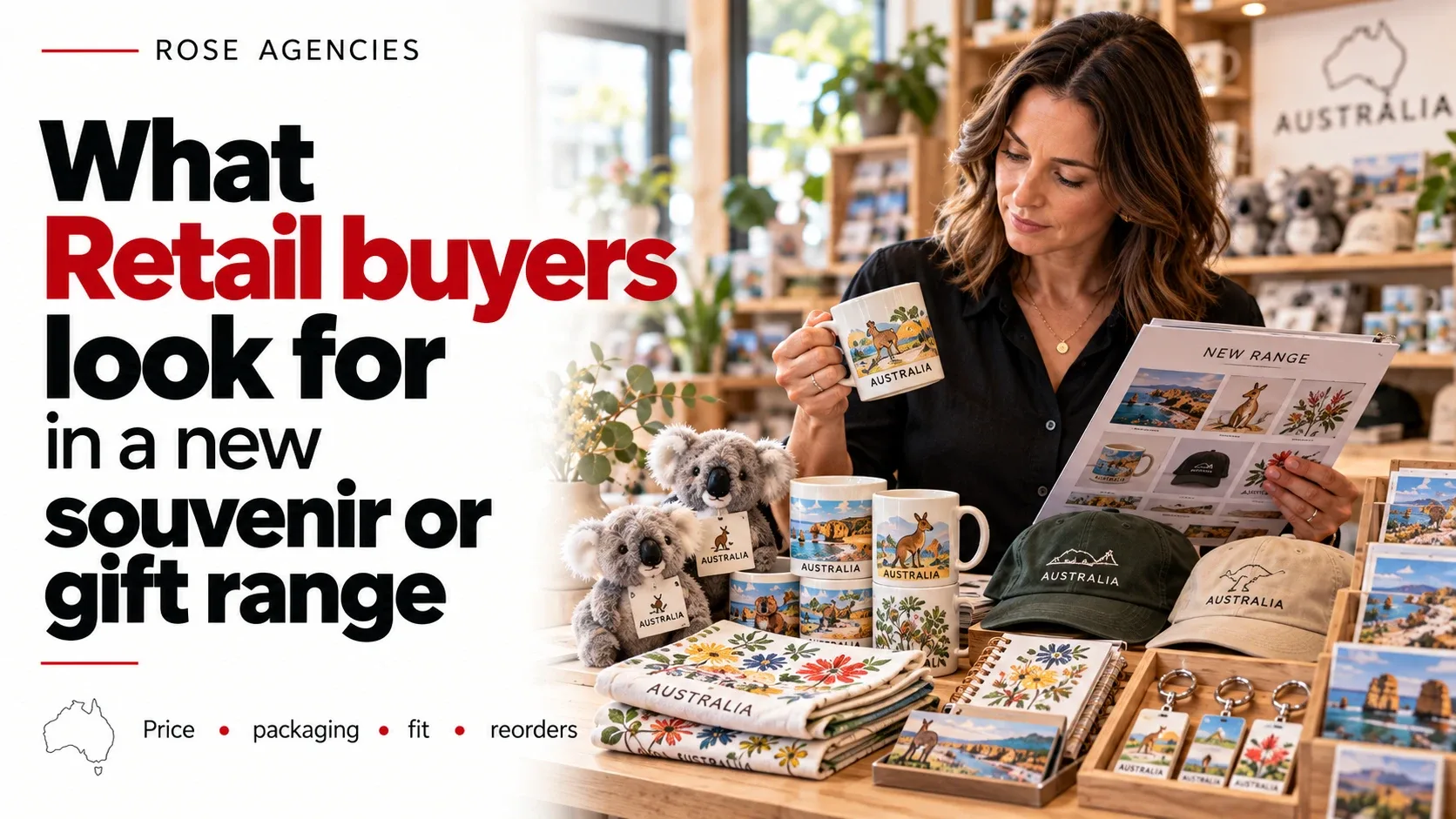
Most of the store owners I call on are running a small business with a counter to serve, stock to unpack and staff to organise. When I show them a new range, they don’t have long. In that time they’re quietly working through the same few questions, whether they say them out loud or not.
If you make or import a souvenir or gift range, knowing those questions in advance makes a real difference. I’ve been presenting ranges to retailers since 1979, and today I call on 227 stockists across 132 towns and suburbs. Here’s what buyers look for.
Will my customers buy it?
This is the first and biggest question. A store owner knows their customers better than anyone. They know whether their visitors are families on school holidays, international day-trippers, caravanners heading north for winter or locals buying a birthday present.
So the buyer is picturing the product on their shelf and their customer picking it up. Products that are tied to the place, like a town or region name, a local animal or a landmark, often get the quickest yes. That’s why destination-branded lines like souvenir magnets and hats are so steady in tourism retail.
It also depends on the kind of store. A pharmacy, a newsagency, a surf shop and a visitor centre all sell souvenirs, but they suit different products. I’ve written about where souvenirs really sell among my own stockists.
Does the price work?
Buyers look at two prices: what they pay, and what their customer will pay. The gap between them has to be worth the shelf space.
- The retail price needs to suit how people shop on holiday. A lot of souvenir buying is a quick decision at the counter.
- The wholesale price needs to leave the store a fair margin at that retail price.
- A clear recommended retail price helps. It saves the buyer working it out on the spot.
If the numbers don’t work for the store, nothing else about the product will save it.
Is it ready to sell?
A store owner wants to unpack a box and have it on the shelf the same day. That means:
- Packaging that protects the product, looks good and suits a small display
- Barcodes where the store uses a point-of-sale system, so it can be scanned at the counter
- Clear product codes and pack sizes that match the catalogue and the invoice
- Display options where they make sense, such as a stand, hooks or a counter unit, because shelf space in a small shop is precious
Products that need a lot of work before they can be sold are a harder sell, however good they are.
How much do I have to buy?
Small retailers are careful with cash, especially outside their peak season. A buyer will often prefer to start small, see what sells and reorder. Sensible minimum orders and mixed cartons make that first order much easier to say yes to.
Timing matters too. Stores plan their buying around their busy months, and the best time to show a range is before they’ve committed their budget for the season. I’ve written more about tourism retail seasons in Australia.
Can I get more when it sells?
This one doesn’t always get asked out loud, but it’s on every experienced buyer’s mind. There’s nothing worse for a store than finding a best-seller and then not being able to get it again in the middle of the season.
Buyers want to know that reorders will be supplied, that lead times are realistic, and that someone will answer the phone if there’s a problem. A brand with a track record of reliable supply has an advantage over one that doesn’t, even if the products are similar.
Who’s behind it?
Finally, buyers like dealing with people they know. When a range comes from someone who already calls on them, understands their store and their season, and has supplied them reliably before, it’s an easier conversation.
That’s a big part of what an agent brings. When I show a store a range, I already know the store, what sells there and what doesn’t, so I can suggest the lines that suit it rather than the whole catalogue. I currently represent Local Bloke, Kato Designs, Sundowner Souvenirs and Souvenirs Australia, and you can see where my stockists are on the stockist map.
If you make or import a product
Before you approach stores, check your range against these questions: the right customer, a price that works, ready to sell, a sensible first order and reliable reorders. If you’d like a step-by-step version, I’ve written about how to get your product into gift shops.
If your range is ready and suits tourism and gift retail, I’d be happy to have a look.
See how representation works, or get in touch about your range.
If you run a store
These are the same questions I ask on your behalf before I bring a range to you. If you’re looking for products that suit your customers, your season and your space, I can help you choose without overcommitting.
Book a visit, ask for range advice or see the products I can bring you.